Key Takeaways
- Pump houses and well tanks are often heavier and more awkwardly shaped than they appear, making manual or equipment-only placement risky.
- Currituck County’s rural properties frequently have soft, sandy, or uneven ground that complicates access for standard delivery equipment.
- A crane allows precise, controlled placement over a well casing or concrete pad without disturbing surrounding plumbing or grading.
- Site distance from the road, tree cover, and utility lines all factor into whether a crane lift is the safer and faster option.
- Coordinating the lift with well drillers, plumbers, or electricians keeps the project on schedule and avoids repeat trips.
- A properly planned crane lift protects the pump house structure itself, which can be damaged by dragging, tilting, or dropping during a rough placement.
A pump house or well tank enclosure may look small enough to move without a crane. You might think a skid-steer, a truck with a winch, or a few people could handle the job. But these structures can be much heavier than they look, especially when they have concrete floors, insulated walls, or equipment already installed inside. Getting them into the right spot can also be tricky. A pump house may need to sit directly over a well casing, line up with existing plumbing, or fit onto a small concrete pad. There may not be much room for mistakes. That is where a crane can make the job much easier.
A crane can lift the structure, move it into position, and lower it slowly and accurately. Instead of dragging or rolling a heavy structure into place, a crane gives the operator much better control over the final placement. Homeowners are sometimes surprised by the recommendation to bring in a crane for what looks like a small job, but the cost comparison usually favors it once the alternative is fully considered.
Currituck County’s Rural Ground Conditions
Much of Currituck County , North Carolina sits on sandy, low-bearing soil, and many well and pump house sites are located away from the more compacted ground near a driveway or garage. Wooded lots, low-lying areas near ditches, and properties with limited grading around the well site are common. Standard delivery trucks or skid-steers can struggle to reach these locations without getting stuck or rutting the yard, particularly after rain.
A crane, positioned on solid ground near the access road or driveway with outrigger pads to spread the load, can often reach a well site 50 to 100 feet away without ever having to drive equipment across soft or wooded terrain. This matters just as much for protecting the property as it does for protecting the structure being placed. Fewer vehicle trips across the yard means less disturbance to landscaping, septic fields, and existing plumbing runs.
Timing also plays a role in how ground conditions affect a job. A well site that is perfectly firm and accessible in dry weather can become genuinely difficult to reach after a week of heavy rain, which is common during certain stretches of the year in Currituck County. It is pivotal to factor recent and forecasted weather into the scheduling and setup planning, since ground that looks fine on a dry morning can behave very differently by the time equipment is loaded and ready.
Precision Placement Over a Well Casing
Setting a pump house over an existing well casing, or positioning a well tank enclosure to align with buried plumbing, requires the kind of fine control a crane provides and rougher equipment does not. Crane operators can hold a load steady inches above its final position, make small adjustments in response to a ground crew’s guidance, and lower it slowly enough to avoid impact damage to the casing, the pad, or the structure itself.
This matters because a pump house that is set even slightly off-center can create ongoing headaches: doors that do not clear the well cap, awkward plumbing connections, or a structure that needs to be lifted and repositioned after the fact, which costs more time and money than getting it right on the first attempt.
Coordinating With Well Drillers, Plumbers, and Electricians
Pump house and well tank projects rarely involve just one contractor. Well drillers need the casing accessible before and sometimes after placement, plumbers need clear access to make connections, and electricians often need to run service to the pump equipment inside. A crane lift scheduled without coordinating these trades can lead to a structure being set before critical work underneath it is finished, forcing a second, avoidable lift.
An experienced crane services for pumphouses in the Outer Banks, NC work directly with property owners and their other contractors to sequence the lift at the right point in the project. In many cases, this means the well casing and any underground plumbing or electrical rough-in are completed first, inspected, and only then is the pump house or tank enclosure lowered into its final position.
New Construction vs. Replacing an Existing Pump House
New construction projects in Currituck County often plan for a pump house or well tank enclosure from the start, which means the pad, plumbing rough-in, and access route can be designed with a future crane lift in mind. In these cases, coordinating with the builder or well contractor early in the project timeline usually results in the smoothest possible lift, since grading and access decisions can account for crane setup before concrete is poured or landscaping goes in.
Replacing an existing pump house is a different situation. Older properties may have a failing or outdated pump house that needs to come out before a new one goes in, and often the access route that worked when the original structure was delivered decades ago has since been narrowed by fencing, mature trees, or new outbuildings. In these cases, our crew assesses both the removal of the old structure and the placement of the new one as connected steps in the same project, since often both require crane assistance for the same access reasons.
Protecting Septic Systems and Underground Utilities
Rural Currituck County properties frequently rely on septic systems, and the access route to a well site can sometimes cross near a septic field or other underground utilities that were not obvious from a casual look at the yard. Driving heavy equipment across a septic drain field can cause soil compaction that damages the system’s function, which is a costly problem to create in the course of what should be a routine structure placement.
Before setting up, we ask property owners about known septic system locations, buried electrical or irrigation lines, and any other underground infrastructure near the planned access route. A crane’s ability to reach well back from a stable staging area, rather than requiring equipment to drive directly across the yard, is one of the clearest advantages it offers over ground-based delivery methods in situations like these.
Matching the Crane to Access and Reach
Pumphouse and well tank lifts can become difficult when the structure sits far from the road, behind a wooded lot, or on soft ground. A crane may have enough lifting capacity but still lack the boom reach or access needed to safely reach the installation site. Low tree limbs, overhead power lines, narrow driveways, and wet ground can also make crane positioning more challenging.
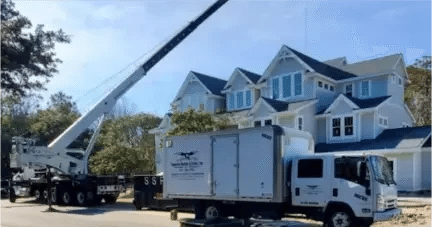
Albemarle Crane Service matches the crane to each property and lifting requirement. Our 26-ton Altec boom truck has a 102-foot main boom, while our 55-ton National crane provides 126 feet of reach for more challenging sites. Before each lift, our crew checks access routes for branches, soft ground, overhead lines, and other obstacles. This planning helps ensure safe and accurate placement of pump houses and well tanks.
Frequently Asked Questions About Pump House and Well Tank Crane Service in Currituck County, North Carolina
Why can’t a pump house just be delivered and set by hand or with a skid-steer?
Prefabricated pump houses and well tank enclosures are often heavier than they appear, and they need to be positioned with precision over a well casing or plumbing connections. A crane allows controlled, accurate placement without the risk of tipping, dropping, or dragging the structure into position.
How far can the crane reach from the driveway to the well site?
It depends on the crane used and site conditions, but our fleet’s boom lengths range from 102 to 140 feet, which covers the majority of well sites even when the structure needs to sit well back from the road or driveway.
Do you coordinate with our well driller or plumber directly?
Yes. We regularly work alongside well drillers, plumbers, and electricians to sequence the lift at the right point in the project, so underground work is completed and inspected before the structure is set in its final position.
What ground conditions do you check before the lift?
We assess soil bearing capacity, moisture, slope, and access route width before setting up. Sandy or low-bearing soil common in Currituck County often calls for outrigger pads to spread the crane’s load safely.
Can this type of job be done same-day?
In most cases, yes. Pump house and well tank placements are typically shorter jobs, and with two cranes available 24/7, we can often accommodate same-day or short-notice scheduling.
Summary Checklist: Key Requirements of the Pump House or Well Tank Lift
| Factor | Why It Matters | Priority |
| Accurate weight and dimension assessment | Confirms the right crane and rigging for the structure | High |
| Ground bearing check along access route | Sandy or wet soil common in Currituck can affect crane setup | High |
| Precision placement over well casing | Prevents misalignment with plumbing and future rework | High |
| Coordination with well, plumbing, electrical trades | Avoids setting the structure before underground work is done | High |
| Boom reach matched to setback distance | Reduces need to reposition the crane mid-job | Moderate |
| Bonded and insured crew | Protects the property and structure if anything unexpected occurs | Moderate |
Final Advice
Setting up a pump house or well tank might look like a simple delivery job, but the reality on the ground in Currituck County, sandy soil, wooded access routes, and the need for precise placement over a well casing, tells a different story. A crane turns a job that could easily go wrong into a controlled, predictable process, and doing it right the first time saves property owners from costly rework down the line.
Whether you’re building a new structure or replacing an old one, a crane lift may be part of the project. The same applies to well repairs that require temporary removal of the enclosure. Here are few important things to note –
- Plan the crane lift early
- Do not leave it until the other work is finished
- Early planning helps keep the project on schedule and avoids delays.
- Crane companies can join a project planning call early and help coordinate the lifting work from the start.
Albemarle Crane Service has supported homeowners, well drillers, and contractors throughout Currituck County and the greater Outer Banks with exactly this kind of precise, small-structure lift since 2017. With two cranes available 24/7, same-day service, we are ready to help you get your pump house or well tank set correctly the first time.