Key Takeaways
- Certified cranes are essential for beachfront HVAC installations because they provide the reach, lifting capacity, and stability needed for heavy rooftop equipment.
- Coastal conditions create unique safety challenges, including sandy soil, strong winds, and limited access, which cranes are specifically designed to handle.
- Certified crane operators improve safety and precision by understanding load charts, wind conditions, and roof structural limits, reducing the risk of accidents and property damage.
- Crane services help meet insurance and permit requirements, ensuring compliance and protecting property owners during beachfront HVAC projects.
Placing HVAC equipment on beachfront roofs presents unique challenges that bucket trucks cannot safely overcome. Outer Banks, North Carolina properties face sandy soil, coastal winds, limited access, and heavy HVAC units that demand certified crane expertise. Many homeowners and contractors mistakenly assume bucket trucks can handle rooftop HVAC installations, but this approach creates dangerous tipping risks, insufficient lifting capacity, and potential roof damage. Bucket trucks lack the vertical reach, stability, and weight capacity needed for modern HVAC systems weighing thousands of pounds. Certified cranes provide superior safety, precision, and compliance with OSHA regulations and municipal permit requirements. This article explains why beachfront HVAC placements require certified cranes instead of bucket trucks, what risks bucket trucks create, how certified operators ensure safety, and why choosing Albemarle Crane Service guarantees professional, reliable, and safe HVAC roof installations across Kitty Hawk, Corolla, Kill Devil Hills, and the entire Outer Banks community.
Why Bucket Trucks Fail on Beachfront HVAC Installations
Bucket trucks are designed for utility work, electrical repairs, and light tree trimming, not heavy rooftop HVAC installations on beachfront properties. Their primary limitation is lifting capacity:
- bucket trucks typically handle 500 -1,000 pounds maximum, while
- modern HVAC units weigh 2,000-5,000 pounds.
Attempting to lift oversized equipment risks bucket failure, hydraulic explosion, or complete truck collapse. Bucket trucks also lack vertical reach for second-story or higher beachfront roofs, leaving operators unable to position equipment precisely. The outrigger system on bucket trucks requires stable, compacted ground to distribute weight, but beachfront sandy soil cannot support this pressure, causing outriggers to sink and trucks to tip dangerously. Coastal winds amplify this instability, pushing bucket trucks sideways during lifts and creating uncontrolled swinging that damages equipment or injures workers. Bucket truck operators often lack training in load charts, wind dynamics, and roof structural analysis that certified crane operators master, increasing accident risk significantly.
Sandy Soil Creates Dangerous Tipping Risks for Bucket Trucks
Beachfront properties sit on sandy soil that cannot support the concentrated weight of bucket truck outriggers. Outriggers must distribute lifting force across stable ground, but sand shifts under pressure, causing outriggers to sink unevenly. This uneven sinking tilts the bucket truck, creating dangerous tipping conditions that can flip the entire vehicle with the HVAC unit suspended.
Certified crane operators understand soil mechanics and use ground preparation techniques including plywood mats, gravel pads, or crane pads that distribute weight across larger surface areas, preventing sinking. They calculate soil bearing capacity before positioning cranes, ensuring stability even on loose beach sand. Bucket truck operators rarely perform these assessments, assuming their equipment is stable regardless of ground conditions. This assumption leads to catastrophic accidents where bucket trucks tip, hurling heavy HVAC units downward and causing property damage, equipment destruction, and serious injuries. Certified cranes prevent these risks through proper ground preparation and weight distribution calculations.
Coastal Winds Destabilize Bucket Trucks During Lifts
Outer Banks coastal winds frequently reach 30–40 mph, creating dangerous conditions for bucket truck HVAC lifts. Bucket trucks have high centers of gravity and narrow wheel bases, making them susceptible to wind pushing them sideways during lifts. When wind hits the extended bucket arm with a suspended HVAC unit, it creates uncontrolled swinging that can slam equipment against buildings, snap rigging cables, or cause the truck to tip.
Certified crane operators monitor wind speeds continuously using handheld meters, pause operations when winds exceed safe limits (typically 20 mph for heavy lifts), and use counterweight calculations to stabilize cranes against wind forces. Cranes have wider wheel bases, lower profiles, and engineered counterweight systems that resist wind instability far better than bucket trucks. Certified operators also position cranes with wind direction considered, angling equipment to minimize wind resistance. Bucket truck operators rarely monitor wind or adjust for wind dynamics, increasing accident risk dramatically during coastal HVAC installations.
HVAC Unit Weight Exceeds Bucket Truck Capacity
Modern HVAC units designed for beachfront homes weigh between 2,000–5,000 pounds, far exceeding bucket truck lifting limits of 500–1,000 pounds. Attempting to lift oversized equipment beyond rated capacity causes hydraulic system failure, bucket arm collapse, or complete truck structural damage. Overloading bucket trucks also destabilizes the vehicle, increasing tipping risk even on stable ground.
Certified cranes like Albemarle’s 55-ton Peterbilt Boom Truck handle 50,000+ pounds safely, providing a massive capacity surplus for HVAC units. Certified operators read load charts determining exact capacity at different boom angles and distances, ensuring lifts stay within safe limits. They calculate total weight including rigging, cables, and attachment hardware, not just the HVAC unit itself. Bucket truck operators often ignore load charts or miscalculate weights, overloading equipment and creating catastrophic failure risks. A certified crane operator can prevent these disasters through precise weight calculations and capacity verification.
Limited Access and Obstacles Block Bucket Trucks
Beachfront properties often have narrow driveways, palm trees, overhead power lines, and landscape obstacles that prevent bucket truck access. Bucket trucks require 12–14 feet width and significant clearance for arm extension, which many beachfront roads cannot provide. Certified cranes have smaller footprint options including articulating boom trucks that navigate tight spaces, maneuver around trees, and position directly where needed. Cranes can lift equipment over obstacles using extended boom angles that bucket trucks cannot achieve due to limited range of motion. Certified operators plan lift paths considering all obstacles, positioning cranes strategically to avoid collisions. Bucket truck operators struggle with limited access, often refusing jobs or attempting dangerous maneuvers that damage property. Certified crane services like Albemarle specialize in tight beachfront access, providing solutions that bucket trucks cannot match.
Certified Operators Ensure Safety and Compliance
- NCCCO-certified operators meet industry standards for crane operation, safety protocols, hazard recognition, and regulatory compliance.
- Thorough pre-lift inspections help identify issues with cables, hydraulics, brakes, and structural components before lifting begins.
- Proper planning prevents accidents, as certified operators evaluate roof load limits, lift requirements, and site conditions before placing HVAC equipment.
- Clear communication and OSHA compliance ensure safe coordination with ground crews while reducing the risk of fines, permit issues, and project delays.
- Insurance and liability protection are strengthened when certified operators are used, as many insurers require certified crane services for coverage.
Albemarle Crane Service: Certified HVAC Roof Experts
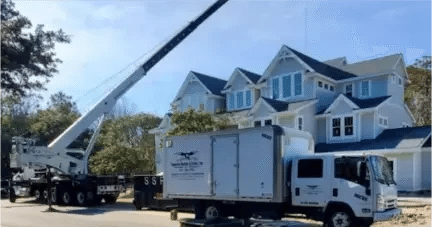
Albemarle Crane Service is a certified, Kitty Hawk-based crane company specializing in beachfront HVAC roof installations across Kitty Hawk, OBX, Corolla, Coinjock, Avon, Buxton, Moyock, Kill Devil Hills, Nags Head, and Dare county. Our team boasts an NCCCO certified crane operator ensuring highest safety standards. We operate a 26-ton Altec Boom Truck and 55-ton Peterbilt Boom Truck for precise HVAC lifts.
Albemarle is bonded, insured, offers same-day service, 24/7 emergency availability, and competitive pricing. Contact Albemarle Crane Service at (252) 999-9110 to Request Your Free Quote for certified beachfront HVAC installation.
Frequently Asked Questions About HVAC Equipment Placement on Beachfront Roofs in North Carolina
Why can’t bucket trucks handle beachfront HVAC installations?
Bucket trucks lack capacity (500–1,000 lbs vs. 2,000–5,000 lb HVAC units), vertical reach, and sandy soil stability needed for beachfront roofs.
What weight can certified cranes lift for HVAC?
Albemarle’s 55-ton crane lifts 50,000+ pounds, safely handling all HVAC unit sizes.
Do beachfront permits require certified crane operators?
Yes, municipalities and insurance companies require NCCCO certification for beachfront HVAC lifts, denying uncertified operations.
How do certified operators handle coastal winds?
Certified operators monitor wind speeds, pause when exceeding 20 mph, and use counterweights for stability.
Summary Checklist: Beachfront HVAC Installations
| Situation | Action Required | Use Certified Crane? |
| HVAC unit over 1,000 lbs | Weight verification | Yes. Critical |
| Second-story or Higher Roof | Vertical reach assessment | Yes. Essential |
| Sandy Beach Soil Location | Ground preparation | Yes. Critical |
| Coastal Winds Above 20 mph | Wind monitoring | Yes. Urgent |
| Narrow Driveway Access | Access evaluation | Yes. Essential |
| Palm Trees or Obstacles | Lift path planning | Yes. Recommended |
| Insurance or Permit Required | Certification verification | Yes. Critical |
| Emergency HVAC Replacement | Rapid response needed | Yes. Urgent |
Final Advice
For beachfront HVAC roof installations, safety and compliance should always come first. Choose NCCCO-certified, bonded, and insured crane operators who understand coastal challenges such as sandy soil, high winds, and limited site access. Certified cranes provide the reach, stability, and lifting capacity needed for heavy HVAC units, while bucket trucks often cannot safely perform these lifts. Before work begins, request a detailed lift plan that includes roof load assessments, equipment specifications, and safety procedures. Regular HVAC inspections can help identify replacement needs early, allowing installations to be scheduled safely and efficiently. For reliable beachfront HVAC placement, work with an experienced crane operator in Outer Banks, NC that specializes in coastal projects and emergency response. When coastal HVAC installation is needed, contact Albemarle Crane Service now to request your free quote for certified, safe, and compliant beachfront roof HVAC placement.