Key Takeaways:
- Shifting sand, narrow lots, and high-water tables create challenging ground conditions that require specialized outrigger support for heavy machinery in Rodanthe.
- Sudden wind velocity changes off the Atlantic Ocean demand active site monitoring to prevent load drifting and rigging failures during high-elevation lifts.
- Renting local, highly adaptable boom trucks ranging from 26-ton to 55-ton capacities protects fragile coastal infrastructure and nearby structures.
- Compliance with CAMA rules, Dare County building setbacks, and NCDOT Highway 12 right-of-way staging guidelines protects builders from costly work stoppages.
- Hiring an NCCCO-certified, fully bonded, and insured crane operator minimizes structural liability and ensures rapid response to volatile weather.
Building on the Outer Banks presents an array of challenges that standard inland construction crews rarely encounter. In Rodanthe, North Carolina, these difficulties are amplified by the narrow geometry of Hatteras Island, where properties are nestled tightly between the volatile Atlantic Ocean and the Pamlico Sound. Executing a successful construction project here requires meticulous planning, specialized engineering knowledge, and mechanical lifting support.
Whether erecting a classic multi-story coastal home, upgrading commercial infrastructure, or hoisting heavy mechanical components onto elevated platforms, renting a crane is often the most critical logistical step. However, managing a crane rental on this exposed stretch of coastline requires analyzing variables that go far beyond basic lifting capacities. From unstable soil structures to rapid shifts in wind velocity, heavy lifting in Rodanthe demands a tailored approach to guarantee safety, regulatory compliance, and structural integrity.
Understanding the Sand and Substrate Challenges
One of the most immediate physical hurdles when deploying heavy machinery in Rodanthe is the underlying terrain. Unlike inland construction environments characterized by compacted clay or dense bedrock, Rodanthe features deep, shifting coastal sand and a remarkably high water table. This unstable substrate directly alters how a crane distributes its immense operational weight. When a crane lifts a heavy structural load, the downward force exerted through its outriggers increases exponentially. On sandy soil, this pressure can cause localized ground failure, tilting the machinery and endangering the entire job site. To counter this vulnerability, operators must use specialized outrigger pads, heavy matting, or timber cribbing to distribute the machine’s weight across a wider surface area.
Before positioning any lifting apparatus on a Rodanthe site, a thorough assessment of subsurface utilities, septic tanks, and drain fields is essential. Because local homes rely heavily on subterranean wastewater systems, misplacing an outrigger can crush underground infrastructure, causing expensive project delays and environmental hazards.
Navigating Unpredictable Coastal Wind Currents
The Outer Banks environment is defined by near-constant wind. In Rodanthe, wind currents coming off the open ocean can accelerate instantly, creating turbulent aerodynamic forces around elevated structures. For crane operations, wind is a primary safety risk factor that dictates whether a lift can proceed.
Every crane possesses a maximum wind velocity rating defined by its manufacturer, above which operations must be halted. When lifting broad-surface items, such as prefabricated roof trusses, modular home sections, or fiberglass pools, the load can catch the wind like a sail. This creates lateral forces that threaten to pull the crane boom out of alignment or swing the load uncontrollably into nearby power lines, pilings, or adjacent beach homes.
Working with local operators who understand these microclimates is vital. A sudden northeasterly gust can compromise a lifting sequence that would be perfectly safe in calm conditions. Monitoring localized wind data and maintaining strict no-go thresholds for wind speed protects the construction assets, the crew, and the neighboring properties from catastrophic structural failures.
Crane Selection: Matching Capacity to Staging Limitations
Selecting the proper machine for a Rodanthe build is a balancing act between lifting capacity and physical footprint. The lot layouts in this area are notoriously narrow, often bounded by fragile dune structures, shared property lines, and restrictive coastal highways.
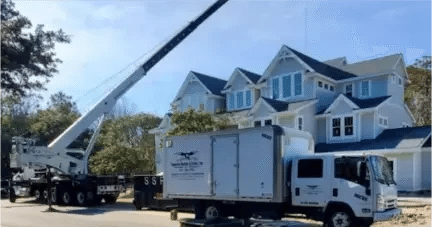
For smaller residential projects, tight access lanes, or mid-tier positioning tasks, a compact and agile vehicle is necessary. A 26-ton Altec Boom Truck provides an exceptional balance of mobility and lifting capability, allowing operators to navigate narrow coastal drives and set up within constrained footprints without sacrificing structural safety.
For larger commercial builds, deep-set pilings, or projects requiring extensive horizontal outreach, a higher-capacity machine is indispensable. A 55-ton Peterbilt Boom Truck delivers the structural reach and heavy lifting capacity needed to transfer major components over existing rooflines or deep onto oceanfront lots. Choosing the right size ensures the machinery operates safely within its load charts without requiring hazardous maneuvers due to an undersized boom.
Compliance with Coastal Regulations and CAMA Guidelines
The coastal fringe of Rodanthe is governed by strict environmental and municipal regulations designed to protect the fragile barrier island ecosystem. The Coastal Area Management Act (CAMA) dictates clear rules regarding development, setbacks, and land disturbance near oceanfront shorelines and estuarine waters.
When planning a crane lift, project managers must verify that the machine’s setup zone does not breach protected dune lines or encroach on public beach access points. Staging heavy machinery within public rights-of-way or on township-maintained roads typically requires specific encroachment permits and coordinated traffic control strategies, particularly along Highway 12.
Furthermore, noise ordinances and designated construction hours must be respected to maintain community standards. Securing a rental provider who is intimately familiar with Dare County’s regulatory landscape ensures that all operations proceed legally, avoiding costly work stoppages or environmental fines.
Precision Positioning for Elevated Mechanical Infrastructure
Rodanthe is highly vulnerable to storm surges and flooding and local building codes require residential and commercial structures to be significantly elevated on wood or concrete pilings. Consequently, critical mechanical components, most notably commercial and residential HVAC units, must be installed on high utility platforms well above the base flood elevation.
Lifting complex, heavy mechanical equipment to these elevated platforms requires extreme precision. Manual rigging or makeshift lifting strategies are dangerous and carry a high risk of damaging the expensive components or compromising the building’s exterior framing. Using a mobile boom truck allows technicians to lift HVAC units, heavy electrical sub-panels, or large storage containers smoothly, holding them perfectly steady while installation crews secure them to their elevated mounts. This approach reduces manual labor requirements and minimizes installation time, protecting sensitive equipment from drops or impacts.
Protecting Adjacent Infrastructure and Proximity Logistics
The density of popular rental zones in Rodanthe means that construction projects often take place mere feet away from occupied properties, elevated decks, and active power grids. This proximity leaves zero margin for error during heavy lifting operations.
When a crane swings a load, the operator must account for the tail-swing of the counterweights as well as the path of the boom overhead. Unauthorized movement over an adjacent roofline or drop zone creates severe liability concerns and structural hazards.
Professional crane operators conduct exhaustive pre-lift briefings to chart the exact path of the load from the delivery truck to the final installation point. By utilizing precise rigging techniques, tagline control, and clear communication channels, the crew ensures that the payload never compromises the safety of nearby structures, utility lines, or pedestrians.
When executing complex construction lifts in the challenging environment of Rodanthe, partnering with an experienced, locally equipped heavy-lift crane service firm in Rodanthe, North Carolina is essential. Albemarle Crane Service has been providing expert crane support across the Outer Banks since 2017, bringing unmatched local insight, technical precision, and reliable performance to every job site. Utilizing an advanced fleet that includes a highly manoeuvrable 26-ton Altec Boom Truck and a heavy-duty 55-ton Peterbilt Boom Truck, their team handles everything from residential framing and elevated HVAC installations to marine transfers and large storage container placement. Available 24/7 for critical structural demands, Albemarle Crane Service prioritizes site safety and punctuality, offering flexible weekend appointments and same-day response options to keep your project moving forward without delay. Contact their team today at (252) 999-9110 to secure a comprehensive, no-cost estimate for your next project.
Frequently Asked Questions About Hiring a Crane Rental in Rodanthe, NC
What types of construction lifts do you perform in Rodanthe, North Carolina?
We handle a wide range of tasks, including lifting roof trusses, placing modular home sections, installing elevated HVAC units, positioning storage containers, setting up fiberglass pools, and lifting marine craft or specialized building materials.
Can your equipment operate safely on the sandy terrain of Rodanthe?
Yes. Our operators are highly experienced with Outer Banks soil conditions and utilize specialized outrigger pads and cribbing techniques to properly distribute weight and maintain total machine stability on sandy substrates.
Are your crane operators certified for complex residential builds?
Absolutely. Our team features National Commission for the Certification of Crane Operators (NCCCO) certified personnel, ensuring that all rigging, lifting, and positioning sequences adhere to the highest professional safety standards.
How do you handle sudden wind changes during a lift?
We continuously monitor localized wind speeds and match them against our trucks’ specific manufacturing load charts. If wind gusts exceed safe operational thresholds, we temporarily halt the lift to protect your structural assets.
Do you provide emergency crane services after major coastal storms in OBX?
Yes, we offer 24/7 emergency availability and same-day service across the OBX. This allows us to quickly assist with urgent needs like removing fallen trees from structures or securing compromised building materials.
Is Albemarle Crane Service fully insured for large construction sites?
Yes, our business is fully licensed, bonded, and insured. We prioritize complete operational transparency and accountability to protect both your construction crew and your property.
Can I book a crane service for a weekend installation?
Yes. We understand that construction timelines can be tight and unpredictable, which is why we offer weekend appointments by request to fit seamlessly into your project schedule.
How do I know which crane size is right for my project?
Our team evaluates your specific material weights, required boom reach, and property access limits to pair your project with either our agile 26-ton Altec truck or our powerful 55-ton Peterbilt unit.
Summary Checklist: When to Call for Removal
| Condition | Risk Level | Recommended Action |
|---|---|---|
| Tree on Public Right-of-Way | High Regulation | Check with local borough or municipal authorities before any removal or significant pruning work |
| Tree in Floodplain, Wetland, or Protected Slope | High Regulation | Confirm environmental permit requirements and zoning approvals before clearing vegetation |
| Shared Boundary Tree | Legal Risk | Verify ownership and obtain written consent from all affected property owners before removal |
| Emergency Storm Hazard on Private Property | Low Regulation | Document the hazard with photos and arrange emergency mitigation or removal as quickly as possible |
| Healthy Tree on Private Property | Low Regulation | Verify local ordinances or HOA restrictions before scheduling routine tree removal |
Final Advice
Successfully managing heavy lifting equipment for a construction project in Rodanthe requires shifting your operational focus away from general builder parameters and tailoring your staging setup explicitly to barrier island conditions. Sand instability, sudden wind bursts, and restrictive property boundary lines present real safety vulnerabilities that can halt work or compromise nearby coastal property structures if unaddressed. Before moving any heavy equipment to your site, check the underground layouts for existing septic fields, active utility pathways, and concrete pilings to avoid crushing underground infrastructure. Ground staging preparation should always include wide outrigger distribution mats or extensive timber cribbing to properly distribute crane weight across the deep sand. Additionally, construction crews must watch ocean weather patterns closely and set strict wind-velocity cutoff numbers, as sea breezes can easily turn building panels or framing sheets into dangerous, wind-blown sails.
Never try to cut corners with undersized equipment or uncertified rigging personnel, since the narrow staging lanes of Highway 12 leave zero room for mechanical alignment errors. By taking a proactive approach and scheduling work sequences with a certified & reliable crane service firm in Rodanthe, North Carolina who understands these exact coastal terrain issues, ensure structural safety and keep your build fully compliant with environmental codes. If you need dependable, high-precision crane rental solutions tailored specifically to the unique environment of Rodanthe, contact Albemarle Crane Service today at (252) 999-9110 to discuss your lifting schedule.