Moving storage containers across difficult terrain is not a standard lift. Uneven ground, soft soil, mud, steep slopes, rocky surfaces, and limited access all introduce risks that normal lifting equipment is not designed to handle. When these conditions are ignored or underestimated, container placement can quickly turn into delays, damaged equipment, or serious safety incidents.
Successfully lifting and placing containers on challenging terrain comes down to three things: understanding the ground conditions, choosing the right lifting equipment, and following proven safety practices throughout the lift.
Why Difficult Terrain Changes Container Lifting
Difficult terrain directly affects stability. Soft or muddy ground can cause equipment to sink or shift under load. Uneven or rocky surfaces make it harder to level cranes and properly deploy outriggers. Slopes reduce lifting capacity and increase the risk of tipping if the load radius is miscalculated.
Remote and undeveloped sites often combine several of these challenges at once. Ground preparation may be minimal, access routes may be narrow, and overhead clearance may be limited. In these environments, standard truck-mounted cranes and forklifts are often unsafe or unusable, making specialized lifting solutions necessary.
Why Rough Terrain Cranes Are the Preferred Choice
Rough terrain cranes are specifically designed for unstable and uneven job sites. They feature large, deep-tread tires, wide stances, and four-wheel drive systems that allow them to maintain traction and balance where other equipment cannot.
Unlike standard mobile cranes, rough terrain cranes can operate effectively on soft soil, gravel, slopes, and uneven ground without extensive site preparation. Their maneuverability allows operators to position containers accurately even when access is tight or the ground conditions are less than ideal. This makes them the most reliable option for container lifts on difficult terrain.
Lifting Capacity and Container Weight Considerations
Container weight plays a major role in equipment selection. A standard 20-foot shipping container weighs around 5,000 pounds when empty, while a 40-foot container weighs roughly 8,800 pounds. Once interior modifications, insulation, electrical systems, or structural reinforcements are added, the total weight can increase significantly.
Rough terrain cranes typically offer lifting capacities ranging from 30 to well over 100 tons, depending on the model and configuration. This range allows them to safely lift both standard and heavily modified containers, even when additional reach is required due to uneven ground or placement constraints.
Forklifts, by comparison, are often limited by both lifting capacity and terrain. Many modified containers cannot be lifted from underneath at all, making crane lifting the only viable option regardless of ground conditions.
Other Equipment Options for Challenging Sites
In some situations, alternative lifting equipment may be appropriate. Crawler cranes perform well on extremely soft or muddy ground because their tracked systems distribute weight evenly, reducing ground pressure. They are commonly used in wetlands, shallow water, or areas where rubber-tired equipment would sink.
Knuckle boom cranes offer flexibility and reach, especially when containers must be lifted over obstacles or placed in tight spaces. Their ability to articulate allows for precise positioning, though they are not suitable for all terrain conditions.
Container lifting jacks can be used on low-volume sites where speed is not critical. They are portable and cost-effective, but slower and less efficient than crane-based solutions and generally unsuitable for complex or high-risk placements.
Safety Considerations on Difficult Terrain
Safety is the most critical aspect of container lifting on challenging ground. Ground stability must be assessed before the crane arrives. Outriggers should only be placed on firm, level surfaces, and crane pads or mats must be used to distribute weight and prevent sinking.
Many crane accidents occur due to improper outrigger setup rather than equipment failure. Outriggers should never be placed over voids, soft spots, or unverified ground.
Overhead hazards must also be identified in advance. Power lines, nearby buildings, trees, and other structures can limit swing radius and create serious risks during lifting. Weather conditions are another key factor. High winds can cause containers to swing unpredictably, and lifts should always be postponed if lightning is present.
Load Control and Communication
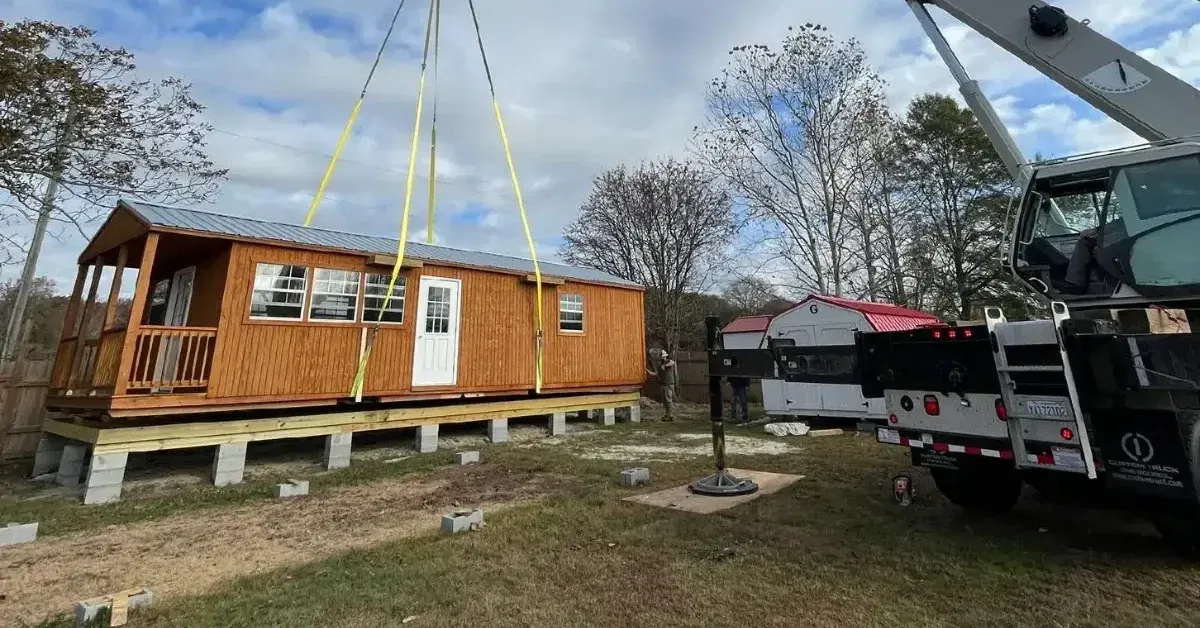
Containers should always be lifted vertically to maintain control and prevent structural stress. Tag lines should be attached to control rotation and minimize sway, especially in windy conditions.
Guide ropes should be secured to one or more corner castings without knots or loops that could snag. These allow ground crews to guide the container into position safely without placing themselves under the load.
Clear communication between the crane operator and ground personnel is essential. Standard hand signals, radios, and a designated signal person help prevent confusion and reduce the risk of miscommunication, particularly when visibility is limited.
Proper Container Lifting Methods
Top lifting requires proper rigging and the use of spreader bars. A standard four-leg sling attached directly to the top corner castings can introduce compression forces into the container roof, which containers are not designed to handle lengthwise. Using approved spreaders transfers these forces away from the container and allows for a vertical lift in compliance with ISO standards.
Bottom lifting is an alternative when overhead clearance is limited. Specialized attachments connect to the lower corner castings, placing load stress on the container’s stronger floor frame. This method can be effective but may not be suitable for containers with floor modifications or limited access to bottom corners.
All shipping containers include standardized corner castings that serve as lifting and securing points. These castings are designed to handle lifting forces when used correctly and with proper equipment.
Site Preparation and Access Planning
Proper site preparation significantly reduces risk and improves efficiency. The work area should be cleared of debris and obstacles to allow safe crane positioning and full outrigger deployment.
In some cases, ground reinforcement with timber mats or steel plates is necessary to create a stable working surface. Adequate space must be available not only for the crane itself, but also for boom swing radius and load placement.
When placing containers near buildings or other structures, access to all four corners is important for attaching and removing rigging. Ladders should be available if top lifting points are used.
Cranes vs Forklifts on Rough Ground
Cranes are generally faster and safer for placing containers on difficult terrain. They allow precise placement, reduce manual labor, and can handle locations that forklifts simply cannot reach.
Forklifts require flat, stable ground and accessible fork pockets. On uneven terrain or with modified containers, forklifts are often impractical or unsafe. In these cases, crane lifting is not just preferred, but necessary.
Cost and Efficiency Considerations
Renting a rough terrain crane can reduce overall project costs by minimizing labor, reducing setup time, and eliminating the need for multiple pieces of equipment. Their versatility allows them to perform multiple lifts across a site without repositioning support machinery.
Large gantry cranes, commonly used at ports, are impractical for most container placement projects due to their cost and infrastructure requirements. Rough terrain cranes provide a far more efficient solution for construction, industrial, and remote site applications.
Planning a Successful Container Lift
Successful container lifting on difficult terrain requires careful planning. Ground conditions, container weight, overhead clearance, access space, weather, and crane capacity must all be evaluated together. Load charts should always be consulted, as lifting capacity decreases as reach distance increases, especially on uneven ground.
Modern rough terrain cranes are equipped with safety systems such as load moment indicators, wind sensors, and boom angle monitoring. These features help operators make informed decisions and reduce the risk of overloads or instability during lifts.
Final Thoughts
Lifting storage containers on difficult terrain is not a job for standard equipment or rushed planning. Rough terrain cranes provide the stability, mobility, and lifting capacity needed to place containers safely in challenging conditions. When combined with experienced operators, proper site preparation, and strict safety procedures, they allow container placement to be completed efficiently and without unnecessary risk.