Key Takeaways
- A crane is useful when a shed must pass over a house, fence, pool, or other obstacle.
- Tight Outer Banks lots often prevent trailer-based shed moves.
- Shed weight alone does not determine crane size; boom reach and operating radius also matter.
- Sandy or wet ground requires a site review before crane setup.
- Accurate photos, dimensions, and access details lead to a safer and more accurate quote.
You need a Crane Service Sheds In Outer Banks, NC to move or position a shed on challenging coastal terrain when it is too large for a trailer, access is blocked, the lot is tight, or the structure must be lifted over a house, fence, pool, or dune. A crane gives the moving crew controlled vertical lifting when dragging or rolling the shed would damage the building, the property, or nearby utilities.
Navigating residential lots across the OBX area frequently requires moving around sensitive sand dunes, elevated homes, swimming pools, and custom fencing. Dragging or rolling a heavy building across these features risks severe damage to your turf, hardscaping, and surrounding landscape elements. Ground level transport can also place excessive weight on hidden septic lines, irrigation systems, and shallow underground utilities, leading to unexpected property repairs.
When Does a Shed Move Require a Crane?
A shed move requires a crane when ground-based equipment cannot safely reach, lift, or transport the structure. The main factors are shed weight, dimensions, lifting points, travel distance, ground conditions, and obstacles between the crane setup area and the final placement site.

A professional crane company evaluates the entire lift rather than focusing only on the shed. A lightweight shed can still require a crane if it must pass over a home or fence. Conversely, a heavy shed may be movable by truck or trailer if the property has clear, stable access.
These 7 situations below are the most common reasons a crane makes sense for shed relocation in the Outer Banks.
1. The Shed Must Go Over a House, Fence, or Pool
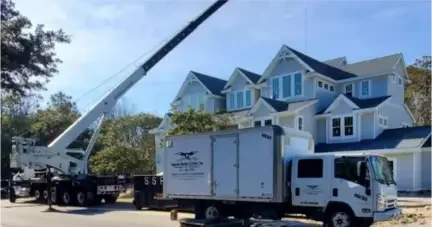
A crane is often the best solution when a shed must be lifted over an obstacle that cannot be removed or driven around. Crane operators can lift the shed vertically, swing it over the obstacle, and set it on its new foundation with controlled movement.
This situation is common on compact beach properties where a shed sits behind an elevated house. The shed may have been installed before a fence, deck, pool, HVAC unit, or neighboring structure limited access. Trying to drag a shed through a narrow side yard can crack siding, twist the frame, damage a fence, or harm landscaping.
The lift plan must account for the shed’s weight, the required boom reach, and clearance from power lines. OSHA requires employers to maintain safe procedures when cranes operate near energized overhead power lines, making site inspection essential before the lift begins. OSHA’s crane safety guidance explains why equipment setup, operator qualifications, and hazard planning matter on every crane job.
2. Your Property Has a Narrow or Blocked Access Route
A crane makes sense when a shed cannot be reached by trailer, skid steer, rollers, or a shed-moving truck. Narrow beach-lot driveways, gates, utility equipment, landscaping, and closely spaced homes often block ground access.
A crane can remain on the street, driveway, or another approved setup area while lifting the shed into the backyard. This avoids tearing out fencing or removing landscaping simply to create a temporary travel path. It can also reduce the amount of property disturbance compared with driving heavy machinery across the yard.
Before scheduling, measure the width of gates and driveways, note overhead wires, and identify any parked vehicles or utility boxes. Sharing those details early helps Albemarle Crane Service select the right crane and prepare an accurate lift plan.
3. The Shed Is Too Large for Conventional Moving Equipment
Large sheds are difficult to move safely on the ground because their size creates flexing, wind exposure, and clearance problems. A crane is especially useful for sheds with wide footprints, tall walls, lofts, finished interiors, or heavy roofing materials.
Many prefabricated sheds look simple from the outside but weigh more than expected once flooring, wall framing, roofing, shelves, insulation, doors, and stored items are considered. A crane lift keeps the structure level when proper rigging points are used, reducing the chance of racking or structural damage.
The safest approach is to provide the shed’s length, width, wall height, roof style, and construction material. If available, send the manufacturer’s specifications. Exact dimensions help determine the gross load and the clearance needed during the lift.
4. The Ground Is Sandy, Soft, or Too Wet for Heavy Moving Equipment
A crane can be a better option when sand, saturated soil, or soft ground makes trailer or truck access unreliable. Outer Banks conditions can change quickly after heavy rain, coastal flooding, or storm surge, and soft ground may not support repeated traffic from loaded equipment.
Crane setup still requires stable ground and proper planning. Depending on the conditions, the crane crew may use outrigger mats to spread the load and protect pavement or soil. The site must support the crane, the shed load, and the forces created while the boom is extended.
The Federal Highway Administration (FHWA) notes that poor soil support can affect the stability of heavy equipment and construction operations, which is why site conditions should never be guessed. FHWA geotechnical resources provide background on how soil conditions influence safe project planning.
If the ground is questionable, photographs and a site visit can help determine whether the crane can be set up safely or whether additional ground protection is needed.
5. The Shed Needs to Be Set on an Elevated or Hard-to-Reach Pad
A crane is often the most practical tool when a shed must be placed on an elevated platform, behind a retaining wall, beside a raised home, or on a pad that ground equipment cannot reach. The crane allows the crew to lower the shed directly onto the prepared location.
This type of placement requires accuracy. The foundation must be ready before the crane arrives, including level blocks, runners, anchors, or a slab if the shed manufacturer requires one. A last-minute foundation issue can delay the lift and create extra crane time.
Homeowners should also confirm setbacks, permits, and placement rules with the local jurisdiction before relocating the shed. In Dare County and other Outer Banks communities, zoning and flood-related requirements can affect where accessory structures may be placed.
6. The Shed Must Be Moved Without Damage
A crane makes sense when protecting the shed is more important than using the lowest-cost moving method. Dragging a shed across uneven ground can stress the floor system, pull walls out of square, damage skids, or break windows and doors.
This is especially important for newer sheds, custom-built structures, finished backyard offices, storage buildings with electrical work, and sheds that will be resold. A controlled lift allows the crew to keep the structure suspended and level while moving it over obstacles.
The shed must be empty or nearly empty before lifting. Furniture, lawn equipment, boxes, tools, and stored materials add unknown weight and can shift during the move. Removing contents also makes the lift calculation more reliable.
For larger relocations, review Albemarle Crane Service’s crane rental and lifting services to determine whether a 26-ton, 55-ton, or 100-ton crane fits the job.
7. The Move Involves a Long Reach From the Street
A crane may be needed when the only setup location is far from the shed’s pickup point or final placement location. Crane capacity decreases as boom length and operating radius increase, so a shed that seems light may still need a larger crane when the lift occurs across a long yard.
The operating radius is the horizontal distance from the center of the crane’s rotation to the load. More radius means less available lifting capacity. This is why crane size cannot be selected based on shed weight alone.
A 55-ton crane, for example, does not lift 55 tons at every boom length or radius. The operator uses a manufacturer load chart to confirm the allowable capacity for the exact configuration. Albemarle Crane Service reviews these details before the job so the crane is sized for the real lift, not the number printed on the side of the machine.
What Information Should You Provide for a Shed Crane Quote?
The best crane quote starts with accurate job details. Photos from multiple angles are helpful, but measurements and access information are equally important.
Provide these details when requesting a quote:
- Shed length, width, and height.
- Estimated shed weight or manufacturer specifications.
- Roof type, wall material, and whether the shed has a loft.
- Photos of the shed and the planned new location.
- Distance from the crane setup area to the shed.
- Obstacles such as homes, trees, fences, pools, decks, and wires.
- Surface conditions, including sand, grass, pavement, or wet ground.
- Whether the shed will be lifted empty.
- Requested move date and any access restrictions.
Can a Crane Move a Shed Safely Near Power Lines?
A crane can move a shed near power lines only when the job is planned around safe clearance and applicable utility requirements. Overhead electrical lines are a serious hazard, and a crane operator may need to change the setup area, use a different boom configuration, or coordinate with the utility company before the lift.
Never assume a line is insulated or safe to work near. Do not attempt to guide a suspended shed by hand unless the crane crew directs the process and the site is clear of electrical hazards. Crane work should be handled by trained operators and qualified riggers.
Work With Albemarle Crane Service
Moving a shed in the Outer Banks does not always require a crane, but a crane is often the safest choice when access is limited, the structure is oversized, or obstacles block a ground move. The right equipment protects the shed, your home, and the surrounding property.
Albemarle Crane Service provides professional lifting support for shed moves, building placement, construction projects, marine work, and other heavy-lift needs. For a clear recommendation, share your shed dimensions, photos, access details, and destination location with the crane team.
Frequently Asked Questions
How much does it cost to use a crane to move a shed?
Crane costs depend on crane size, travel time, setup difficulty, lift radius, job duration, and site conditions. A simple close-range lift costs less than a long-reach lift over a home or around power lines. Requesting a site-specific quote is the most accurate way to price the work.
Can a crane lift any type of shed?
Most sheds can be lifted if they have enough structural strength and can be rigged safely. The crane company must confirm the shed’s weight, construction, lifting points, and condition before approving the lift.
Do I need to empty the shed before a crane moves?
Yes. Emptying the shed removes shifting weight, reduces the total load, and protects your belongings. It also helps the crane operator calculate the lift more accurately.
How far can a crane move a shed?
The distance a crane can move a shed depends on the crane’s capacity, boom length, operating radius, shed weight, and site layout. A professional crane operator uses the load chart to determine whether the planned reach is within safe limits.
Can a crane place a shed behind a house?
Yes. A crane can lift a shed over a house when the site has adequate clearance and the crane can be safely positioned. The lift must account for the shed’s weight, boom reach, overhead obstacles, power lines, and the required placement location.
Do I need to prepare the shed’s new location before the crane arrives?
Yes. The new location should have a level, stable foundation or prepared support system before the lift begins. Having the site ready helps the crane crew place the shed efficiently and avoids unnecessary delays or additional equipment time.
Ready to Relocate Your Outer Banks Shed Without the Stress?
Don’t let tight lots, coastal sand, or high-reaching obstacles stall your project or put your property at risk. Whether you need a short lift over a fence or a complex, long-reach placement over an elevated Outer Banks home, Albemarle Crane Service provides the exact equipment, local expertise, and precision rigging to get the job done right.
Call our Outer Banks crane experts directly at (252) 999-9110 or Request Your Free Quote to discuss your project details and lock in your free site assessment!